Why Prophets, Mystics and Spiritual Teachers Went Into the Wilderness


From Moses on Mount Sinai to Muhammad in the Cave of Hira and the Buddha beneath the Bodhi tree, some of humanity’s most influential spiritual figures deliberately stepped away from ordinary life. What happened when they did?
Long before meditation retreats, wellness centres and digital detoxes, people were doing something surprisingly familiar:
They disappeared for a while.
Into mountains. Deserts. Caves. Forests.
Sometimes they fasted. Sometimes they prayed or meditated. Sometimes they simply withdrew from society.
And remarkably often, they returned with a new understanding, teaching or direction.
The traditions differ enormously, and not every story has the same historical certainty. But the pattern itself is fascinating.
1. Moses: 40 Nights on Mount Sinai
Place: Mount Sinai
Time: 40 nights
Practice: Withdrawal, fasting and encounter with God
Purpose: Divine communion and receiving guidance
Result: Covenant and commandments
Moses gives us one of the clearest examples.
The Qur’an describes an appointment of 30 nights plus another 10, completing 40 nights. The Hebrew Bible likewise describes Moses remaining there for 40 days and 40 nights, traditionally without food or water.
The symbolism is powerful:
leave ordinary society → ascend the mountain → fast → encounter the Divine → return carrying guidance.
2. Jesus: 40 Days in the Wilderness

Place: Wilderness
Time: 40 days
Practice: Solitude and fasting
Purpose: Testing and preparation
Result: Beginning of public ministry
Before Jesus begins his public ministry, the Gospels place him in the wilderness for 40 days, fasting and confronting temptation.
Notice when it happens.
Not after his mission.
Before it.
His sequence is essentially:
baptism → wilderness → fasting → testing → return → ministry
The retreat becomes preparation for what comes next.
3. Elijah: 40 Days to a Cave

Place: Wilderness → Mount Horeb → cave
Time: 40 days and 40 nights of travel
Practice: Withdrawal and journey
Purpose: Seeking God during crisis
Result: A renewed sense of direction
Elijah travels for 40 days and 40 nights to Horeb and enters a cave.
Then comes one of the Bible's most beautiful contemplative moments: the Divine is not associated with the dramatic wind, earthquake or fire, but with the quiet manifestation afterward.
In other words:
Perhaps what matters most isn't always found in the loudest experience.
Sometimes it appears when everything becomes quiet.
4. Muhammad: Repeated Retreats in the Cave of Hira

Place: Cave of Hira, outside Mecca
Time: Repeated retreats lasting many nights; early biography describes roughly a month annually
Practice: Solitude, contemplation and worship
Purpose: Spiritual withdrawal and contemplation
Result: Beginning of Qur’anic revelation
This one requires an important correction.
You may hear that Muhammad spent 40 days in Hira.
The strongest early hadith reports don't actually say that.
They describe Muhammad developing a love of solitude and retreating to Hira for many nights at a time, returning for provisions. Early biographical tradition gives the more specific picture of approximately one month each year.
Then, during one of those retreats:
Iqraʾ.
“Recite.”
Revelation begins.
What fascinates me here is that solitude wasn't necessarily one extraordinary experiment.
It had become a practice.
5. The Buddha: 7 Days, Then 49 in Later Tradition

Place: Bodhi tree and surrounding area
Time: 7 days in an early account;
49 days in later tradition
Practice: Meditation and contemplation
Purpose: Awakening and its integration
Result: Teaching
The Buddhist version changes the number.
An early Pali account describes the Buddha remaining beneath the Bodhi tree for seven days following awakening.
Later Buddhist tradition develops this into seven weeks, or 49 days, spent around the enlightenment site.
Different number.
Different theology.
But a surprisingly familiar rhythm:
withdraw → become still → see differently → return → teach.
6. Mahavira: Not 40 Days. More Than 12 Years.
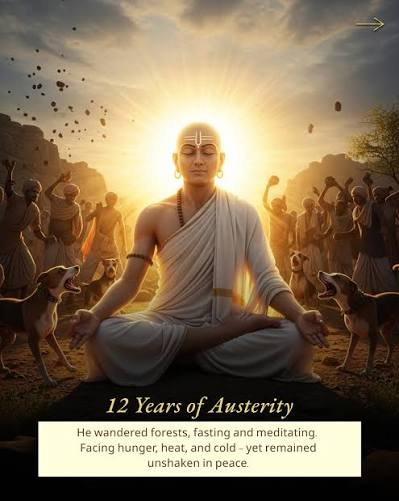
Place: Forests, lonely places and periods of wandering
Time: More than 12 years
Practice: Meditation, fasting and severe ascetic discipline
Purpose: Liberation and knowledge
Result: Kevala-jñāna, traditionally understood as perfect knowledge
If 40 days sounds intense, Jain tradition takes this to another level.
Mahavira is traditionally described as practicing severe asceticism for more than twelve years before attaining kevala-jñāna. This wasn't twelve uninterrupted years sitting inside one cave, but included wandering, meditation, fasting and periods of withdrawal.
7. Guru Nanak: Three Mysterious Days

Place: Kali Bein river
Time: 3 days in traditional biography
Type: Mystical withdrawal/disappearance
Purpose: Interpreted spiritually within Sikh tradition
Result: Emergence with a transformative religious message
Traditional Sikh biographies describe Guru Nanak disappearing after entering the Kali Bein river and returning three days later, after which his spiritual mission takes a decisive turn.
This account belongs more clearly to traditional sacred biography, so it shouldn't be treated as historically equivalent to every other example.
But once again:
withdrawal → transformation → return.
So What's Going On?

Put the stories beside each other and something interesting appears:
Society → Solitude → Nature → Less stimulation → Prayer / Meditation / Fasting → Inner confrontation → Insight → Return → Service
That sequence appears remarkably often.
And that last step may be the most important.
They came back.
The cave wasn't the destination.
Neither was the mountain.
The purpose wasn't necessarily to escape humanity.
It was to return to humanity differently.
Why I Love Vipassana
This ancient pattern is one reason Vipassana meditation

resonates so deeply with me.
I'm not suggesting that a modern Vipassana retreat is equivalent to Moses at Sinai, Muhammad at Hira or the Buddha's awakening.
It isn't.
But the underlying human experiment feels familiar:
What happens when I deliberately remove the noise?
No endless conversation.
No entertainment.
No constantly checking the phone.
No performing for other people.
Just observation.
Eventually, you begin noticing something you can easily miss during normal life:
your mind is constantly reacting.
Pleasant sensation?
I want more.
Unpleasant sensation?
Make it stop.
Boredom?
Give me something.
And meditation gives me an opportunity to watch that machinery without immediately obeying it.
That is one of the things I love most about Vipassana.
And That's Also Why Fasting Fascinates Me
Fasting can create another version of the same experiment.
Vipassana reduces mental and sensory stimulation.
Silence reduces social stimulation.
Solitude removes many external distractions.
Fasting temporarily removes one of our most habitual forms of consumption.
Suddenly you get to observe:
Am I actually hungry?
Am I craving?
Am I bored?
Why do I immediately want to satisfy this sensation?
That can turn fasting into more than a food practice. For me, it can also become an observation of desire, habit and reaction.
Fasting, of course, isn't appropriate for everyone, and prolonged or intensive fasting can carry medical risks. Spiritual discipline shouldn't override individual health needs.
Maybe This Is Why “40” Keeps Appearing
Within Abrahamic scripture, 40 repeatedly accompanies transition, testing and preparation:
Moses: 40 nights.
Elijah: 40 days.
Jesus: 40 days.
Noah: 40 days and nights of rain.
Israel: 40 years in the wilderness.
I wouldn't conclude that humans need exactly 40 days to transform.
There is no evidence for that.
I think the symbolism is more interesting:
You enter as one person. Something gets stripped away. You emerge into another phase.
You Don't Need a Cave

Most of us aren't going to Mount Sinai.
We don't need to.
Our modern “cave” might be a meditation retreat.
A silent weekend.
A morning without a phone.
A long walk alone in the forest.
A period of fasting, when appropriate.
Or simply sitting quietly long enough that we stop running from whatever appears next.
Across traditions, the metaphysics differ.
But the human experiment is surprisingly recognizable:
Remove some of the noise and see what remains.
That's why I love Vipassana.
That's part of what I appreciate about fasting.
And perhaps that's the real lesson behind all those mountains, deserts, forests and caves.
The goal isn't simply to withdraw from life.
It's to discover what the silence teaches you, and then bring that person back into the world.
Sometimes Silence Gives Something Back to You
One reason Vipassana has become so meaningful to me is that I have experienced what can happen when I stop filling every empty space.
During a one-day Vipassana retreat, an idea came to me for an Urdu podcast. It was not something I had gone into meditation trying to create. It simply appeared in the quiet.
I acted on it.
That idea became Zindagi Se Guftagu, an Urdu podcast that went on to reach 100,000+ subscribers in roughly two months.
For me, the lesson was not that meditation magically creates successful ideas.
It was much simpler:
Sometimes the signal becomes easier to hear when you remove the noise.
That experience changed how I think about solitude.
Silence is not always empty.
When I stop constantly consuming, talking, scrolling, reacting, solving, or filling every space, there can be room for ideas that were already trying to surface.
That is part of why I keep returning to meditation, silence, nature, and fasting.
I keep coming back to one question:
What becomes audible when everything unnecessary becomes quiet?
You can watch the podcast here: Zindagi Se Guftagu on YouTube
And if you are interested in the practical side of what I later learned about turning a podcast idea into audience growth, I eventually built that experience into: The Viral Podcast Blueprint
The Point Is Not to Escape Life
From mountains and caves to forests, fasting, and meditation halls, the settings have changed, but the underlying impulse is remarkably familiar: step away from the noise long enough to listen.
That is what I love about Vipassana. It is also part of what fascinates me about fasting and intentional solitude. They remove things we normally reach for automatically: conversation, entertainment, food, distraction, stimulation.
And underneath all of that activity, we get an opportunity to observe what remains.
Sometimes what surfaces is uncomfortable. Sometimes it is clarity. Sometimes it is an idea.
But I don’t think the purpose is to stay in the cave.
The purpose is to return.
To return to our relationships, responsibilities, work, creativity, and ordinary lives with a little less noise inside us and perhaps a little more clarity about what actually matters.
Maybe that is one reason human beings have kept returning to silence for thousands of years.
Not because there is nothing there, but because when everything else becomes quiet, we may finally notice what was there all along.
Continue Your Journey
Whether you're exploring Quantum Healing Hypnosis (QHHT) for the first time, researching Beyond Quantum Healing (BQH), or you're already a practitioner deepening your understanding of consciousness, the goal remains the same: greater self-awareness, healing, and meaningful integration.
Explore more expert resources:
Learn about Quantum Healing Hypnosis (QHHT) and what to expect during a session.
Discover Beyond Quantum Healing (BQH) for online sessions from the comfort of your home.
Read real client experiences and answers to frequently asked questions.
Book a private QHHT or BQH session with Ali Christos if you're ready to begin your own journey.
Related Resources
Ready to explore your own questions?


Comments